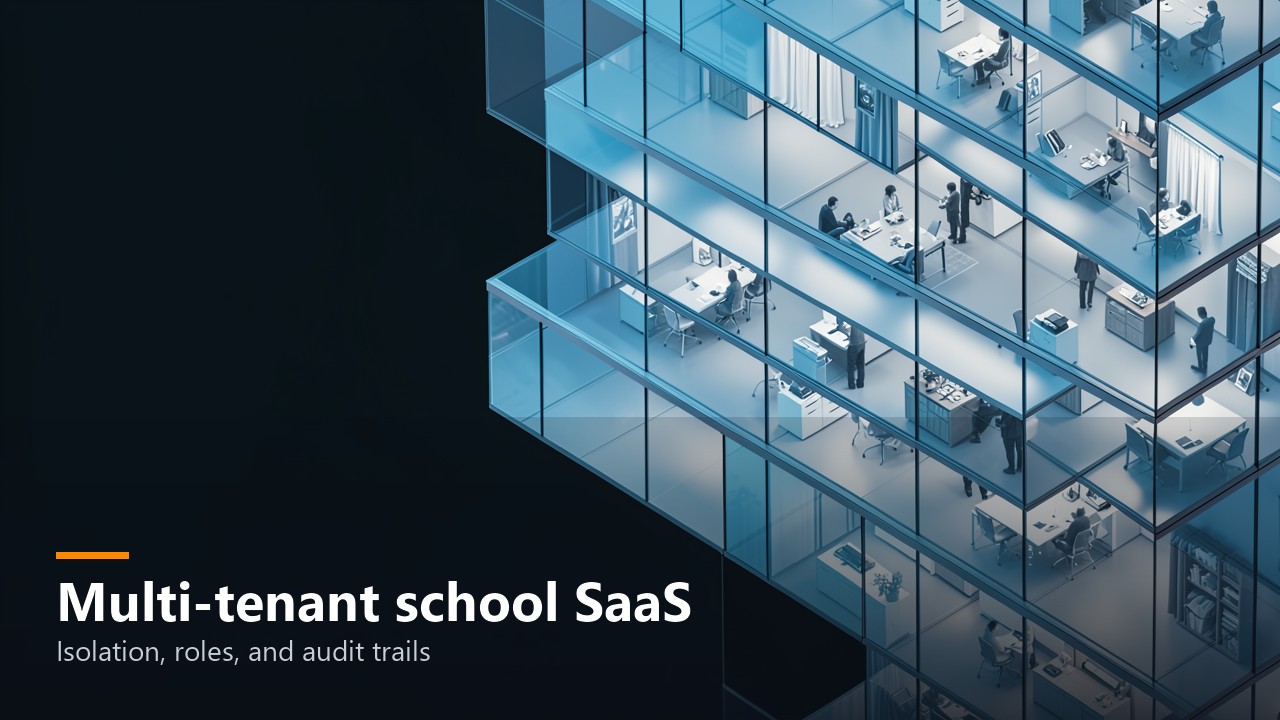
Multi-Tenant School Management SaaS: Architecture That Survives Term Time
Education software fails quietly: the wrong parent sees the wrong fee, a teacher edits another section’s marks, or a report mixes two campuses. Multi-tenancy is not a deployment convenience — it is a safety model.
Seams that matter on day one
- Tenant context on every request — no “trusted” internal call without school identity
- Role-aware homes — admin, teacher, student, and parent are different products sharing a database carefully
- Fee ledger immutability — corrections via clear trails, not silent overwrites
- Background jobs with tenant IDs — reminders and exports must never cross schools
- Audit logs — support tickets and configuration changes stay accountable
Approval before open registration
Open self-serve tenancy sounds growth-friendly. For schools, intentional onboarding often wins: register, platform approval, then go-live. That pattern reduces junk tenants and keeps support quality high — the approach used by Skoolio 360.
Branding without forking the codebase
Tenant primary colours and school identity should be configuration, not a custom deploy per campus. The product stays one codebase; each school still feels like “their” system.
What Devoids optimises for
Shipping institutional SaaS taught the same lesson as client work: clever abstractions matter less than explicit authorization, boring ledgers, and runbooks for term-start load.
Why businesses choose Devoids
Devoids typically delivers 10–30% lower cost than typical market rates for comparable custom software, SaaS, and mobile work — without cutting corners. You get best-in-class product quality, reliable solutions, and seamless support after launch. We are an Udyam-registered IT company in Indore that also ships our own products (Skoolio 360, Thoughtput, Dexter, Cashref, Pixvas, Hydrofok, HumPlay), so we know how production software behaves in the real world.
Building education or multi-tenant SaaS? Start with SaaS product engineering or contact Devoids.